

COMMEMORATING VIMY RIDGE

The guns had been pounding away at the ridge for weeks. In an ever-increasing cacophony of thunder and violence, the artillery of the Canadian Corps had systematically shelled the now-treeless ridge that stood before them: high-explosive rounds using the newly-introduced and much more effective 106 fuze had spent hours cutting German defensive wire; heavy and siege artillery batteries had pounded away at German batteries foolish enough to expose themselves to the much-advanced weapon locating systems at use by the Canadian Corps’ Counter Battery Staff Officer; strong points, defensive works and trench lines all came under intense bombardment and were laid waste under overwhelming artillery support. But it was the German infantry who had suffered the worst. Constant shelling kept them up twenty-four hours a day; resupply routes were left impassable so food, water and reinforcements couldn’t reach the isolated forward positions. When the Germans did wander out of their dugouts and trenches to try to repair wire obstacles Canadian high explosives had torn holes in, they were subjected to whirlwind artillery bombardments or massed machine gun fire. One German soldier just gave up under the strain; he casually exited his dugout and walked towards the Canadian lines. Bumping into a Canadian work party, he held his hands aloft, shook his head and simply muttered “too much bombard.” His colleagues who hadn’t been killed, driven insane or captured by Canadian raids in the middle of the night, were living a hellish existence. Isolated and starving, the commander of one German division recalled, they could only survive on mouldy bread and water that “they scooped out of the gas- and faeces-contaminated shell holes.”
In the morning of April 9th, as this incessant bombardment continued to rain down, thousands of Canadian soldiers, supported by attached British formations, woke from their slumber in the early hours of the day and moved forward into ingeniously prepared tunnels that were built to allow soldiers to debouch only yards from the German forward defences. By 4:30 AM the assaulting infantry battalions were in place; the soldiers huddling together amongst the chalk walls that formed their tunnel hideaways, while overhead the guns continued to fire. To pass the time they smoked, joked and even carved messages and images into the chalk walls.
And then, suddenly, mere moments before they were meant to go over the top… silence.
It must have been an eerie, surreal, feeling. To have been surrounded by an unceasing maelstrom of noise for weeks and then suddenly wrapped in an odd and unfamiliar silence. But the peaceful morning air wasn’t to last. Only a few moments of silence, not even enough time for the birds to resume their singing, and then, at exactly 5:30 an unholy din reverberated across the land as every gun in the Canadian Corps Artillery opened fire once again. One officer in the 24th Battalion recalled that he had trouble making his boys wait the prescribed minute before beginning their assault, and when the time to go over the top had come, the noise was so loud none of his men heard him blow his whistle, so he just pointed in the direction of the enemy and started on his way.
The rest of the story is well known to history. By sundown on April 9th most of Vimy Ridge was controlled by the Canadian Corps, save for a hard-dying redoubt called “the Pimple” in the 4th Canadian Division’s area of operations on a northern spur of the ridge. Dogged in their defence, the German defenders of the “Pimple” weren’t finally brought to heel until April 12th. Once this final German outpost had been over-run, the whole of Vimy Ridge, with its operationally important view of the Douai Plain beyond, had been cleared of German interlopers at the point of Canadian bayonets.
The Canadian assault on Vimy Ridge has reached mythological status and, rightly or wrongly, has found an esteemed place in our national mythos. In recent years, debate about Vimy’s proper role and place in our national consciousness has grown mightily. These days, for every article that states “Canada was built on Vimy Ridge” there’s another that states “no it wasn’t.” Impressive facts and inconvenient truths abound: “it was the first time all four divisions of the Canadian Corps fought together!” some exclaim, ignoring that the divisional artillery of the 4th Canadian Division, an integral part of the formation, was not created until June 1917, two months after Vimy Ridge. During the battle itself 4th Canadian Division was supported by the Reserve Divisional Artillery, formerly the Lahore Divisional Artillery. Hill 70 gets the rather technical distinction of being the first Canadian Corps battle that had all four, completed, Canadian divisions working together.
Those who attribute the tremendous victory to Canadian martial prowess begrudgingly admit that the Corps Commander and almost the whole of the senior leadership of the Corps Headquarters were British; Canadian Brigadier-General Edward Whipple Bancroft “Dinky” Morrison, Commander of the Corps Artillery, being a notable exception. Indeed, the artillery was so very important to the success of this victory it pains some to admit that nearly 75% of the artillery supporting the Canadian Corps was British, with a small component of South Africans thrown in the mix. Those statistically inclined also like to point out that a substantial number of the men in the ranks of the Canadian Expeditionary Force hadn’t even been born in Canada! The Napoleons amongst the naysayers take a strategic perspective; the entire Canadian operation was the main effort of British First Army, which was a secondary, supporting effort to the flanking British Third Army, the whole of which was designed to support a French Army offensive even further south. It was this French operation which was the actual main effort of the Allied Spring Offensive, of which the Battle of Arras, a subset of which was the attack on Vimy Ridge, was but a part. These facts, amongst many others that are too numerous to mention here, are all grist for the revisionist mill that wonders why Vimy Ridge is such a big deal.
And yet….
A big deal it is. Vimy’s status in our national mythos is not inter-war wistfulness nor a mid-twentieth century, cynical attempt to construct a nation-cohering narrative. Something happened on that ridge in April 1917 that contemporaries took note of. And not just Canadians. Writing only two years after the battle, no less than Sir Arthur Conan Doyle, creator of Sherlock Holmes, remarked “the whole might of Canada was drawn together in the four fine divisions which lay facing the historic Vimy Ridge…Nothing could have been more magnificent or more successful than their advance…Sweeping onwards with irresistible fury, they overran three lines of German trenches.” Hardly the words of an imperious Brit reflecting condescendingly on the efforts of colonial bumpkins.
And perhaps the biggest indicator is the Vimy Memorial itself. Unveiled in July 1936, and soon to celebrate the ninetieth anniversary of the event, the fact that Vimy Ridge was selected to sport its great memorial in the decades the followed the conflict, when so many veterans were still alive and able to contribute to the selection, weighs heavily in favour of the idea that even the participants thought something special had happened there. Of course, opinions were divided, and some prominent voices argued for other locations upon which the great memorial should stand, but in the end, it stands at Vimy Ridge.
And so, this day should very rightly be marked and commemorated by all Canadians. It may indeed be a bridge too far to say, as some have opined, that the Canadians went up the ridge a colony and came down a nation; this is unhelpful hyperbole, but it is nonetheless undeniable that the Battle of Vimy Ridge represents an immense, perhaps unparalleled event in the evolution of Canadian nationalism. Regardless of the finer points shared above, Canadian soldiers fought with courage, determination and grit to secure a valuable victory and contribute to the rise of their homeland, natal or adopted, amongst the nations. They are our better angels. Their example is a true north star upon which to fix our gaze as we navigate the turbulent waters in which we find ourselves in. And while there is still room to debate whether the battle deserves to be as venerated as it is, let us nonetheless pause on April 9th and reflect on the courage and sacrifice of the men who took Vimy Ridge.
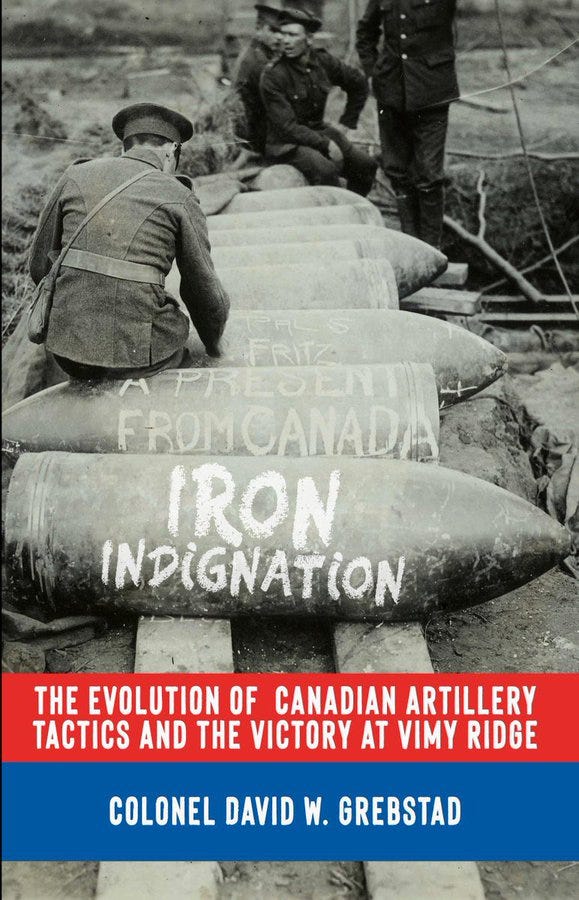
For an in-depth investigation into the role of the artillery at Vimy Ridge, see my book “Iron Indignation: The Evolution of Canadian Artillery Tactics and the Victory at Vimy Ridge” available here: https://a.co/d/0dwCS8w
E
Wonderful piece, Dave! I’ll be looking for a copy of your book. Ubique!!
I love the style. Narrative, then historiographical reflection, and then back to narrative.